P-3 Orion Research Group
The Netherlands
this page was last updated on 10 March 2013
Lockheed Martin P-3 Orion Operators
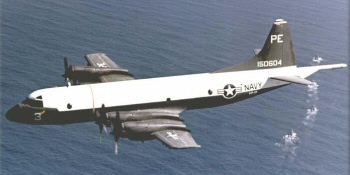
United States Navy (1962)
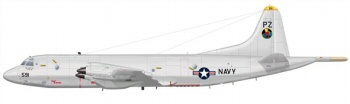
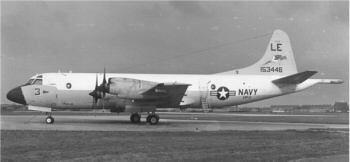
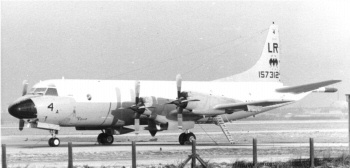
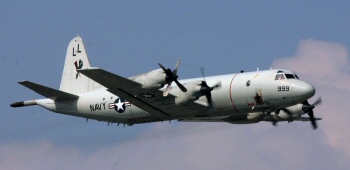
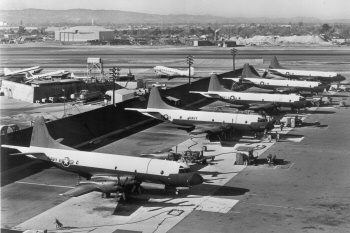
Development of the P-3 Orion was initiated by the USN. Not surprisingly it was a USN Patrol Squadron (VP-8) which started transition training from the P2V-5FS Neptune to the brand new P3V-1 Orion as the first operational squadron in the world. During the next five years fourteen more squadrons exchanged their Neptunes for P-3A Orions, while the latter also replaced the Martin SP-5B Marlin flying boats in five additional squadrons. As from 1966 P-3B's also entered USN service.
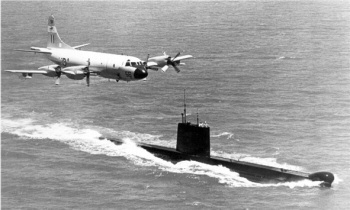
After having played an important surveillance role during the 1962 Cuba crisis, the Orion first saw action during the Vietnam war. In Februari 1965 VP-9 was the first squadron to fly operational P-3A missions in support of the US Forces in and around Vietnam. The USN Patrol Squadrons were responsible for ASW operations to protect Task Force 77, night time radar surveillance over the Gulf of Tonkin and a 900 miles blockade off the South Vietnam coast to prevent provisioning of the Vietcong. During this operation "Market Time" Orions were used to intercept infiltrating cargo ships in the South Chinese Sea. Several P-3s were damaged by automatic weapons and in April 1968 a Cambodian gun boat even shot down a P-3B of VP-26, resulting in the loss of the entire crew. In October 1973 VP-17 completed the final "Market Time" mission. All 13 Pacific Fleet and seven Atlantic Fleet P-3 squadrons have served in Vietnam. Eversince the USN has deployed P-3 Orions to areas of tension all over the world. The most recent examples are the operations in support of the Gulf War (1990-91) and the wars in former Yugoslavia (since 1990).
Modernization of the fleets of the frontline squadrons usually meant the introduction of new, improved Orion variants. VP-26 was the first operational squadron to receive the P-3B in 1966. The P-3C followed in 1969 with VP-56 as the first squadron flying the Charlie. Starting in 1970 eleven reserve squadrons were equipped with P-3As which were retired from the frontline squadrons. Moreover in 1973 the USN sold three P-3As to Spain where they were taken in use by the air force. Because of the introduction of the "Charlie" P-3B Orions became available for reserve squadrons as from October 1977. VP-91 was the first reserve squadron that traded in its P-3As. In the same year another four P-3As were handed over to the Spanish Air Force but this time under a long term lease contract. After a relatively small number of P-3C-I Orions for VP-9, VP-19 and VP-46, the P-3C-II followed in May 1978. It was not before 13 November 1978 that the last operational P-3A mission was flown by a frontline squadron. This particular flight was conducted by VP-44 with BuNo 152173. VP-44 was also the first squadron to be equipped with the P-3C-II. In 1981 VP-11 received the very first squadron to operate P-3C-II½ and VP-40 had the honour to be the first squadron to receive the P-3C-III in 1986.
On 22 March 1990 VP-64 flew the last operational USN P-3A mission. The six hour flight with P-3A BuNo 152158/LU-4 launched from NS Rota in Spain with an 18-man crew and the mission (a simulated attack on an enemy submarine) was completed with succes. The very last P-3A flight was carried out on 12 October 1990 when VP-69 delivered BuNo 152152 to the Museum of Naval Aviation at NAS Pensacola. In the meantime VP-22 had completed the last P-3B mission in frontline service on 11 September 1990. From that moment on the P-3B was only in use with reserve squadrons. Late 1987 the P-3C-III was introduced in the naval reserve force with VP-62 being the first reserve squadron to receive factory fresh Orions. The final P-3B mission was flown by VP-93 and since October 1994 all USN Patrol Squadrons are operating P-3C versions. 68 Orions are being modified for Anti Surface Warfare (ASuW) in the ASuW Improvement Program (AIP) which is well underway. In addition 30 aircraft will be modified to carry and launch Maverick missiles. Up till 2001 99 Orions would have gone through the Sustained Readiness Program (SRP) to increase their technical lifetime to 38 years, but after completion of 13 aircraft the program was terminated because Raytheon E-Systems (the contractor) was overrunning the budget and because of technical problems. Another 19 aircraft went through a simple program which only extended the airframe lifetime with four years. The USN is now looking to the possibility of funding a Service Life Extension Program (SLEP) which is planned to start in Fiscal Year 2002. SLEP will cost $25 - 35 million per aircraft. If SLEP will not be funded it is expected that up to 40 P-3C Orions will be phased out in 2006.
After a long selection process, on 4 June 2004 the USN decided that the P-3C Orions will be replaced by the martime patrol version of the Boeing 737-800ERX. This decision was announced ten days later, on 14 June 2004. A total number of 109 Boeing P-8A’s will be purchased with the first delivery to VP-30 expected in 2012. Two months later, on 2 August 2004, the Embraer ERJ-145 was selected as the replacement for the USN’s EP-3E fleet. The first ERJ-145 is expected to enter service in 2012 as well.
NASA - National Aeronautics & Space Administration (1965)
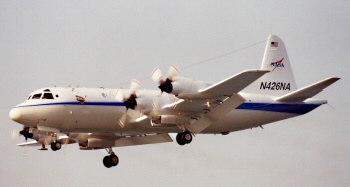
NASA owns two P-3B Orions one of which is operated on behalf of the Wallops Flight Facility of Goddard Space Flight Center (GSFC). The second aircraft is parked at AMARC and used as a spare parts birds. The first NASA Orion was the former YP-3A prototype 148276 which was taken over from the USN in 1965. Until 1977 this aircraft operated with NASA's Johnson Space Center (JSC) as an NP-3A and from then with the Wallops Flight Facility. The aircraft was used as a support platform during various test and evaluation programs. This first Orion was retired early 1993. Its jobs were taken over by a P-3B which was purchased from the USN in 1990 and had been modified with a "glass cockpit" before it entered service with NASA.
Republic of China Air Force (1966 - 1967)
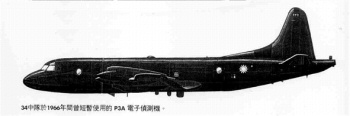
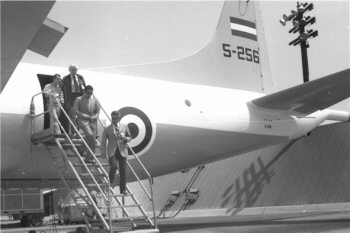
As part of a highly classified CIA's black P-3 program (see the Sneaky P-3 operations page) at least two P-3A Orions were handed over to the Republic of China Air Force (RoCAF) on 19 May 1966 and 12 July 1966. There even was an official handover ceremony on 22 June 1966 in which the RoCAF accepted the aircraft! The Orions were flown by Taiwanese crews and operated by RoCAF 34 squadron on behalf of the CIA. The aircraft were still painted black but received RoCAF markings and at least one was allocated a Taiwanese serial number (777). Their electronic surveillance missions ended on 25 January 1967 and both P-3A Orions left Taiwan on 28 January 1967 and were returned to the USA.
Royal New Zealand Air Force (1966)
The Royal New Zealand Air Force (RNZAF) received five P-3B's in 1966. These aircraft replaced the ageing Sunderland flying boats of 5 squadron and were based at Whenuapai air base. Conversion was completed in 1967. The last Sunderlands were then retired and the flying boat base near Fiji was closed down. In 1983 the five Orions underwent a major systems upgrade under Project "Rigel" which comprised the replacement of all operator stations by Boeing's Universal Display And Control System (UDACS). A prototype aircraft was modified by Boeing, while the remaining four were modified at Air New Zealand. A sixth (ex RAAF) P-3B was purchased from Lockheed in 1985 and after completion of Project "Rigel" all six aircraft were designated P-3K Orions.
A service life extension program, known as "Kestrel" started in 1997 when NZ4204 arrived at the Celsius Hawker Pacific facility at Richmond, Australia. "Kestrel" replaced the outer wings, horizontal stabilizer, center wing lower panels, refurbish the engine nacelles, install new electrical wiring in the wings and add a fuel dump capability. New wings were built and delivered by Daewoo Heavy Industries in South Korea. On 10 October 1998 the first "Kestrel" aircraft succesfully completed test flying and was returned in operational service. The project was completed in 2001 and added another 25 years to the P-3K Orion's technical life time. In the meantime another project ("Sirius") started. "Sirius" was to replace major components of the aircraft's mission equipment. However the new New Zealand government cancelled "Sirius" for budgetary reasons and, even worse, started a study to the possibility of phasing out the Orions. The results of this study were positive for RNZAF’s 5 squadron: the P-3K Orions would remain in service. The next year the government decided to restart a modernization project. On 11 November 2004 one P-3K was deployed to the United Arab Emirates in support of Operation Enduring Freedom. On the 22nd of the same month New Zealand’s Orion fleet passed the 100.000 accident free flight hours milestone, equal to 11½ years in the air. L3 Communications was awarded a contract for the update program of the six Orions on 12 October 2004. L3 Communications will complete the first aircraft in their own facilities in the United States, While New Zealand company Safe Air will modify the remaining five birds. RNZAF Base Whenuapai will most likely be closed down in or before 2006 with 5 squadron moving to Okakea.
Royal Australian Air Force (1968)
The Royal Australian Air Force is the second largest P-3 Orion customer for the Lockheed P-3 production facilities. The first batch of ten P-3B HW Orions replaced the P-2 Neptunes of 11 squadron in 1968. In May 1975 the Australian government ordered another eight Orions, this time P-3C-II's, which were destined for 10 squadron. An additional order for two aircraft was placed in November 1976. Deliveries of the new Charlies started at the end of 1977. At the same time 10 squadron moved from RAAF Townsville (Queensland) to 11 squadron's home base RAAF Base Edinburgh (South Australia, near Adelaide) to keep the costs of introduction of the new aircraft low. Edinburgh already was fully suitable for P-3 operations. The P-3B Orions were traded in at Lockheed as a partial payment for the purchase of ten brand new P-3C-II½ Orions for 11 squadron. The first aircraft of this new batch was delivered in November 1984.
Starting in 1979 all RAAF Orions (P-3B's and P-3C's) were equipped with British AQS-901 acoustic signal processing and display systems, which replaced the usual acoustic systems. The CP-901 is the central computer which links the acoustic, radar and ESM systems online, and generates the tactical displays. The ASQ-901 system in the Australian Orions was identical to the system used in the RAF Nimrod. During 1989 the type designation of the P-3C-II½ Orions was changed into P-3W on request of 492 Maintenance Squadron to be able to better discern the Update II and Update II½ aircraft. To reduce the workload of the nineteen P-3C and P-3W Orions (one aircraft crashed in 1991), it was decided to purchase an additional three (ex USN) P-3B Orions for use as bounce birds and pilot trainers. These three aircraft were modified with P-3C flightdeck systems at NADEP Jacksonville, where they also received strenghtened floors, passenger seats and other modifications, before they entered service with 292 squadron as TAP-3 Orions from August 1997. These aircraft have since been reallocated to 10 and 11 squadrons, resultant from the disbandment of 492 squadron and the allocation of maintenance tasks to the individual squadrons. The acquisition of the TAP-3 aircraft was an element of Project Air 5276 (PA5276) which also incorporated the ASQ-504 digital MAD, the AP-3C modifications and the acquisition of a new flight simulator. In November 1989 Elta (a division of Israel Aircraft Industries) was awarded a contract for the delivery and installation of the AN/ALR-2001 "Odyssey" ESM system for the nineteen RAAF Orions. This ESM system is operated from a seperate work station. The first flight of an Orion with "Odyssey" (A9-657) took place on 24 November 1992. After a twelve months test and evaluation program the remaining RAAF Orions were fitted with the new ESM gear.
The contract for Project Air 5276, meant to replace the mission equipment onboard of 18 RAAF P-3C Orions, was signed in January 1995. The first aircraft (A9-760) arrived at Raytheon E-Systems at Greenville, TX in November 1997 and after an extensive strip down was fitted with the new equipment racks and operator consoles. First flight of the modified aircraft, now known as AP-3C, took place on 19 May 1999. The second aircraft A9-759 was inducted for work at the Boeing Australia facility at Avalon (just outside Melbourne, Victoria) on 18 January 1999. A9-760 arrived back in Australia, at Avalon, in the middle of December 2000. Although the AP-3C program made a good start it is facing a lot of problems resulting in delays. It was not before 20 February 2002 that the first two AP-3C Orions were officially handed over to the RAAF. The 18th and last aircraft was delivered late 2004. In addition to the AP-3C program the RAAF bought the electro-optical infra red system Star Saffire II mid 2004, for installation onboard of its Orions. In the meantime the three TAP-3 Orions were withdrawn from use. The last TAP-3 mission was flown on 18 February 2004. The aircraft were offered for sale but as no potential buyers were interested the RAAF started to use the aircraft as spare part birds. On 30 March 2004 the RAAF Maritime Patrol Group (MPG) was decommissioned and its responsibilities were taken over by the newly formed Surveillance and Response Group (SRG), headquartered at RAAF Williamtown. The Orion squadrons remain being home based at RAAF Edinburgh. Between 9 November 2001 and 6 June 2003 two RAAF Orions were forward deployed in support of Operation Enduring Freedom (RAAF Operation Falconer).
Late 1999, when RAAF Orions were taking part in surveillance missions along the borders of East Timor, some Australian newspapers came out with a story about one or two of the RAAF's P-3C Orions having been modified for electronic surveillance missions. This would have been done under the responsibility of the Defence Signals Directorate under "Project Air 5384" between 1995-98 and is believed to have added "EP-3E alike" communication interception systems to the aircraft's mission suite. The Australian ministry of defence denied the existence of this project, but it is a fact that one aircraft was not involved in the AP-3C program and this single aircraft might be involved in the electronic surveillance missions.
Royal Norwegian Air Force (1969)
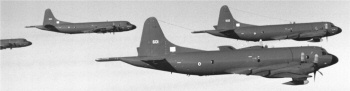
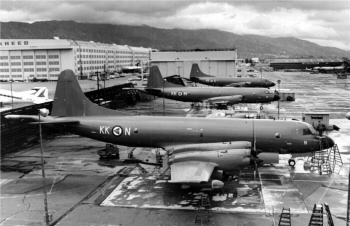
The Royal Norwegian Air Force's 333 squadron was the first P-3 operator in Europe. Five P-3B Orions were delivered to the squadron between January and March 1969 and, after a training period in the United States, Norway's first Orion arrived at Oslo/ Fornebu Airport on 10 April 1969. Seven days later the squadron received its second Orion at Sola air base. The Orions replaced the HU-16B/ASW Albatross amphibians after the Norwegian ministry of defence had chosen the P-3B Orion over the Breguet Br1150 Atlantic and a turboprop-modified Albatross. By the end of the Summer of 1969 333 squadron was declared fully operational with the P-3B, which was at the time the most advanced anti-submarine warfare aircraft above the polar circle. In 1976 the P-3B's were modified at NAS Alameda with several components of the USN TAC/NAV modification. In the same year Norway's Exclusive Economic Zone was enlarged to 200 miles off the coast, making the area of responsibility for the Orions seven times as large as Norway itself. The newly formed Norwegian Coast Guard is responsible for monitoring this large area and 333 squadron is assisting with patrol flights ever since. In 1979 an additional two (second hand) P-3B's were purchased from the US Navy and arrived at the squadron in the Spring of 1980. The lack of funds blocked the purchase of an eighth aircraft.
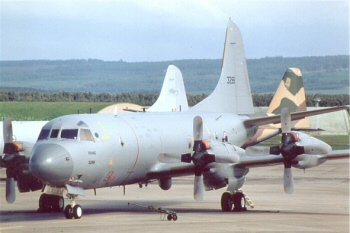
In the mid eighties Norway had a requirement for more modern patrol aircraft. Despite modifications the P-3B was technically obsolete as the Soviet navy had introduced some modern and very quiet submarines. P-3B's 576 and 583 were slightly modified with newly developed equipment at the Naval Air Development Center at Johnsville, PA in February and March 1981. This equipment was possibly used for operational evaluation during Soviet shipping patrols between Iceland and Norway. Negotiations with Lockheed and the US Navy resulted in the purchase of four P-3C-III Orions. The aircraft were delivered between March and July 1989 but it lasted a couple of months before they arrived at Andøya AB because additional ESM and communications systems were fitted in the four Charlies by the US Navy at NAS Moffett Field and at the NADC at Johnsville, PA. The installation of the new ARC-207 HF communication systems lead to some technical problems. These systems were twice as powerful as the communication systems which were in use in the P-3 for the last twenty years. They needed a completely different aerial system. Also the new paint used on the aircraft had a completely different electrical conductivity, resulting in several malfunctions of other equipment onboard. The first P-3C-III (3297) arrived at Andøya on 20 July 1989 and the last Norwegian crew that was trained in the USA returned to Norway with P-3C-III 3298 in August 1989. Five of the seven P-3B Orions were sold to the Spanish Air Force. The first one (600) was delivered to Jerez in Spain on 4 November 1988, while the fifth and last aircraft departed for Spain on 6 September 1989. In June 1990 P-3B 576 was sent to NADEP Jacksonville for modification to P-3N standards. In March 1991 Norway's last P-3B (603) received the same modifications. In 1996 Norway was looking for an additional two P-3C airframes and talked about the purchase of two Pakistan Navy Orions for a while. These purchase plans were cancelled a little later. On 8 December 1997 aircraft 3298 was flown to the Lockheed Martin facility at Greenville, SC to be modified along the lines of the USN AIP program. The program became known as "Update Improvement Program" or UIP. All four Norwegian P-3C-III aircraft went through the UIP which was completed in March 2000. The aircraft have been designated P-3C UIP ever since.
Spanish Air Force (1973)
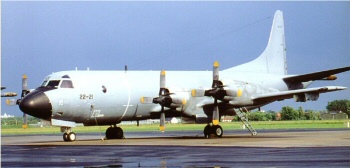
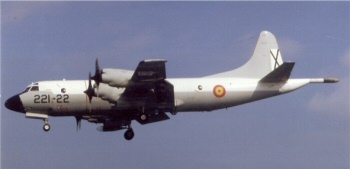
As a replacement for the HU-16B Albatross the Spanish Air Force took delivery of three P-3A Deltic Orions in 1973. The aircraft were bought second hand from the USN and the aircrew training was done with VP-31 at NAS Moffett Field. The number of Orions was too small for a country like Spain, specially after one of the aircraft had crashed in 1977. An additional four P-3A's were leased from the USN in 1979. These aircraft remained in Spanish service until they were replaced with five ex RNoAF P-3B Orions. These were transferred from Norway in 1988 for 4000 million pesetas. The five P-3B's were delivered to Jerez AB by Norwegian crews, where they were put in open storage for a short period. A couple of months later 221 squadron started to operate the Bravoes next to two of the original Alphas.
Three leased P-3A's were returned to the USN, while the fourth one went to the Spanish Air Force museum. The Spanish Orions are operated by a mixed air force / navy crew. Until 1994 their home base was Jerez de la Frontera AB, today they operate from Moron AB. In 1998 the Spanish ministry of defence expressed its interest in two additional P-3B airframes to replace both Alphas remaining in service. Both the US government and the Norwegian government were contacted about the price and availability of P-3B's at AMARC and the P-3N's respectively. However, the P-3A's are still in service albeit as logistic support and pilot trainer platforms. In February 2002 one Spanish P-3B was deployed to Djibouti in support of Operation Enduring Freedom. By the end of 2002 EADS/CASA was awarded a contract for an extensive modification program for the P-3B mission equipment suite. This involved the installation of the so-called Fully Integrated Tactical System (FITS). Almost a year later the first modified P-3B (now called P-3M) was returned to service with 221 Escuadrón.
Islamic Republic of Iran Air Force (1974)
The former Imperial Iranian Air Force (IIAF) ordered six P-3F Orions in 1973. Although these aircraft are a derivative of the P-3C, they have several characteristics which are typical for the P-3B like the search light, wingtip mounted ESM and aerial outfit. The aircraft were delivered between 24 July 1974 and 31 January 1975 and went to an Iranian training detachment with VP-31 at NAS Moffett Field first. Early in April 1975 the aircraft departed for Iran. At least one of the P-3F's was modified to launch Harpoon missiles. This particular aircraft crashed and before the other five could have been equipped with the necessary Harpoon systems all relations between Iran and the USA were ended because of the 1978 revolution. Iran is not even mentioned as a P-3 operator anymore in official Lockheed publications. Original plans called for the installation of the Rockwell-Antonetics "Ibex" system onboard of two P-3F Orions and two Boeing 707's, to enable the aircraft to carry out electronic intelligence (ELINT) missions but since the ELINT missions would have been flown from high, unpaved runways "Ibex" was installed in four C-130 Hercules' instead of in the P-3F and Boeing 707. Future plans foresaw the purchase of an additional twelve Orions but these had never been delivered. The IIAF ordered three P-3F Orions in 1978 but these were completed as P-3C's for the USN (160610 - 160612). After the revolution the air force was renamed Islamic Republic of Iran Air Force (IRIAF). P-3F operations were limited due to the lack of spare parts and maintenance support. The Israeli intelligence service reported two operational P-3F Orions in 1984 which were noted over the Persian Gulf frequently. In 1985 two Orions were reported to be written off, two were stripped for spare parts and one was unserviceable. In other words: only one P-3F was in a flying condition while most of the equipment onboard was unserviceable. Strangely enough the operational availability of the P-3F Orions improved in 1986 when at least two (maybe three) aircraft were noted in flying condition. In 1995 two P-3F Orions were observed flying at the same time. These operational improvements could have been the result of illegal deliveries of military hardware (including P-3 spare parts) from the USA to Iran, known as the "Iran-Contra scandal".
NOAA - National Oceanic & Atmospheric Administration (1975)
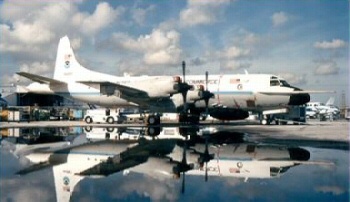
The US Department of Commerce purchased two WP-3D Orions in 1975. Both aircraft are operated by the NOAA Office of Aircraft Operations (OAO) at McDill AFB and are not only used for hurricane and weather reconnaissance missions but also for international meteorological and oceanographic research programs. WP-3D's were used in support of studies to acid rain, polar ice, windshears at airports and a World Meteorological Organization Program in Geneva, Switzerland. WP-3D Orion operations are ordered by the Dept. Of Commerce, other government agencies and universities. The aircraft have a specialized suite of equipment dedicated to their missions. The belly radome houses a C-band radar antenna, while the large tail boom contains an X-band side looking radar which is turning 360 degrees. A pitot tube on the left hand wing tip provides static measurements and a large boom on the side of the flight deck enables the crew to measure wind speed. A "sniffer" on top of the fuselage checks the oxygen level in the air.
Royal Canadian Air Force (1980)
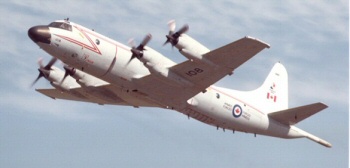
The Canadian government ordered eighteen maritime patrol aircraft, based on the Lockheed P-3C Orion, on 27 November 1975. These aircraft were delivered to the Canadian Armed Forces in 1980 and 1981 as CP-140 Auroras. The first Canadian crew was trained up by Lockheed at Burbank with the rest done at CFB Greenwood with 404(MP)squadron. To relieve the Aurora fleet three CP-140A Arcturus training aircraft were purchased in 1989. The Arcturus is a simple version of the Aurora, used for pilot training, logistic support and surface surveillance flights like coast guard duties and fishery patrols. The Aurora fleet currently constitutes Canada's only airborne strategic surface (sea and land) surveillance capability and is a critical element of Canada's maritime combat team. Eighteen Aurora aircraft entered service in 1980 followed by three CP-140A Arcturus aircraft (same airframe with a limited surveillance suite) in 1993. The airframe is a derivative of the USN P-3 Orion aircraft and the avionics and sensor subsystems are derived from the USN S-3A Viking aircraft.
The fleet is divided amongst both coasts. The West coast, Comox, British Columbia (19 Wing Comox) equipped with five Auroras and the East Coast, Greenwood, Nova Scotia (14 Wing Greenwood) equipped with 13 Auroras and three Arcturus. National Procurement initiatives are ongoing to extend the airframe life of both aircraft types. It is expected that the life of the airframe, currently stated as 2010, can be extended to 2015 through normal depot level maintenance activities. Negotiations are underway with the USN for Canadian involvement in the USN P-3 Service Life Assessment Program (SLAP) to determine what structural initiatives will be required to extend the airframe life of the Aurora beyond 2015. In 1998 an incremental approach was supported, and AIMP (Aurora Incremental Modernization Project) received Departmental approval to move ahead. The aim of AIMP is to rectify the Aurora’s capability deficiencies through an incremental replacement of existing avionics systems with modern avionics systems. The modern avionics will address the disparity between the current mission suite and the contemporary requirement to conduct non-combat, peace support and combat operations in complex and potentially hostile environments. Interoperability with national and allied organizations will also be addressed. After some delays the AIMP finally started in April 2002. Aurora 140101 was the first one to be completed and it made its first flight on 6 May 2004. Between December 2001 and 19 June 2003 Canadian Auroras flew 4.300 hours in support of Operation Enduring Freedom (Canadian Project Apollo). End 2004 Canada ordered five (+ ten options) L3 Wescam MX-20 electro-optical infrared surveillance systems for installations onboard the CP-140.
General Offshore Corporation (1981 - 1992)
On behalf of the USN the General Offshore Company used two UP-3A Orions in support of a sonobuoy quality assurance program between 1981 and 1992. The program started as early as 1965 when the USN contracted the Vocaline Company. This company used P-2 Neptunes borrowed from patrol squadrons at NAS Brunswick and tested buoys in test areas off the New England coast. In 1968 Vocaline received aircraft on loan from the Naval Air Systems Command and started to operate from Saint Croix (Virgin Islands). In 1970 the contract was taken over by Vocaline Air Sea Technologies (VAST). They started to use P-3A Orions for the test program. After VAST, Tracor Marine was contracted for a couiple of years. This company operated two Orions out of Saint Croix, where better weather conditions and deeper water created the excellent environment for test programs of new sonobuoys. In 1981 General Offshore took over responsibilities for the tests. Their two Orions were modified with a sonobuoy launching tube in the weapons bay. The standard P-3A launching tubes were also used during the test program. Video cameras in the fuselage captured the launch of the buoys and all kind of data (such as speed, height, temperature) were collected and registered onboard of the Orions. Besides testing of newly produced buoys, General Offshore also sample checked buoys from USN stocks as well as prototypes of newly developed buoys. The Orions visited NAS Brunswick every two weeks for maintenance. Mid 1992 it was decided that General Offshore was no longer allowed to make use of the Orions. The company modified a Gulfstream 1 with P-3 launching equipment and monitoring systems. This ended the Orion era for General Offshore.
Japanese Maritime Self-Defense Force (1981)
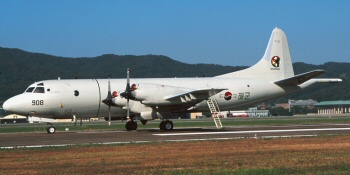
An evaluation of suitable succesors for the Lockheed SP-2H and Kawasaki P-2J Neptunes of the Japanese Maritime Self Defense Force (JMSF) resulted in an initial order for 45 P-3C-II½ Orions. The first three aircraft were manufactured and assembled by Lockheed at Burbank, CA. The next four aircraft were manufactured by Lockheed as so-called "knock-down" kits and assembled by Kawasaki Heavy Industries at Gifu in Japan. All further Japanese Orions were completely built by Kawasaki. In August 1980 the "Japanese Navy P-3C CONUS Training Group" with USN VP-30 at NAS Jacksonville started the training for the first Japanese P-3 crews. The first JMSDF P-3C-II½ Orion was delivered to Jacksonville on 29 April 1981, followed by the second and third aircraft in August and September. After completion of the training program these three Orions departed for Japan on 21 December 1981. The first flight of the first Orion assembled by Kawasaki took place in March 1982. Mid 1987 the Japanese givernment announced that all Orions would be modified to Update III standard. Kawasaki's assembly line switched to P-3C-III production in 1988. On 11 February 1995 the JMSDF was the proud owner of a fleet of 100 ASW Orions. A study for a replacement aircraft has already been started and forsees the purchase of a fleet of new MPA's from 2010.
© P-3 Orion Research Group / 1997 - 2017
Royal Netherlands Navy (1981 - 2006)
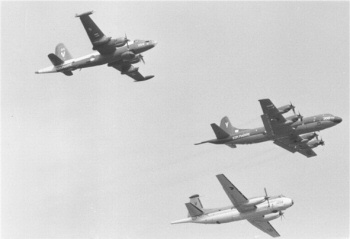
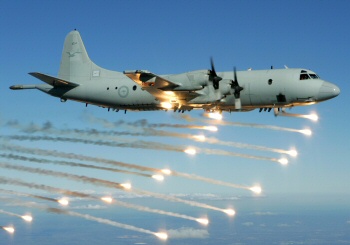
The RNLN took delivery of its first P-3C-II½ Orion on 5 November 1981. This aircraft was flown to NAS Jacksonville and later augmented by the next three RNLN Orions. These four aircraft were used during the initial P-3 conversion training, which was given by USN's VP-30. After four crews had successfully completed the training course they ferried the first four RNLN Orions from NAS Jacksonville to RNLNAS Valkenburg in The Netherlands on 21 July 1982. Upon entering Dutch airspace the first aircraft was welcomed by the RNLN's last operational SP-2H Neptune of VSQ320 and an SP-13A Atlantic of VSQ321. These aircraft arrived over RNLNAS Valkenburg in close formation. The introduction of the P-3C-II½ went smoothly. From the start of the RNLN P-3 program the Dutch crews gained recognition and respect for their outstanding results during international exercises. The 13th and last Orion was delivered on 14 September 1984. MARPAT established a permanent detachment at NAS Keflavik, Iceland on 18 October 1985. The single Orion stationed at this NATO base was operated in close cooperation with the USN's PATRONKEF. An interesting new mission for the MARPAT Group was the deployment of the Orion as an airborne reconnaissance platform over land in support of NATO's operation "Eagle Eye" over Kosovo. Things went fast after the Orion was chosen as the most suitable platform for this mission. In November 1998 the RNLN launched a modification program for three aircraft. These were modified with the FLIR Systems Star Safire electro-optical sensor and a Pioneer relay system for the real time transmission of Star Safire video and photo images. Furthermore these aircraft were equipped with missile warning receivers and chaff/flare dispensers for self-protection. The modifications were done by the USN at NAS Patuxent River and after completion of the job and a quick training course for the first crew, the MARPAT Group successfully deployed the first Orion to NAS Sigonella on 13 February 1999. Two days later this aircraft conducted the RNLN's first overland reconnaissance mission. Ever since the MARPAT Group frequently deployed an Orion to NAS Sigonella for a period of two weeks to conduct reconnaissance missions in close cooperation with PATRON Sigonella, the USN patrol squadron deployed to this Italian NATO base.
In May 2000 both the parliament and government had authorized the plans for a major update of the Orion fleet. The update program, known as "Capability Upkeep Programme" or CUP was very similar to the USN's Anti surface warfare Improvement Program (AIP) and the RNoAF's Update Improvement Program (UIP). This would have guaranteed a continued and extended international cooperation on the subject of maritime patrol missions. Unfortunately in 2001 the MARPAT Group lost three of its Orions for budgetary reasons. But the CUP program started with the first aircraft leaving RNLNAS Valkenburg on 7 June 2002. It was planned that seven P-3C-II½ Orions were to go through the full CUP, while three more aircraft would get a simplified update as these aircraft were to be utilized for coast guard and drug interdiction duties. However the future of the RNLN P-3 fleet changed dramatically when in June 2003 the Dutch MoD announced that the Orions were to be sold, RNLNAS Valkenburg was to be closed down and the MARPAT Group and its squadrons were to be decommissioned as early as 1 January 2004. The Dutch parliament did not approve these plans and called for a study to an international MPA Group in which the RNLN would participate. The MoD’s plans were delayed but on 31 October 2003 the Dutch and German Ministries of Defense signed a letter of intent for the sale of ten P-3C Orions to Germany. On 28 April 2004, a month before the first upgraded P-3C would return home, the worst scenario became true: the parliament approved the budget cuts and sacrificed the entire MARPAT Group. On 17 September 2004 The Netherlands and Portugal signed a letter of intent for the sale of five RNLN Orions to Portugal, leaving only eight aircraft available for Germany. On 15 November 2004 a final agreement for the sale of eight P-3C CUP Orions to Germany was signed. As of 1 January 2005 the P-3C and P-3C CUP Orions lost their operational status and on 14 January 2005 both squadrons 320 and 321 were decommissioned. Remaining Dutch crews and aircraft were brought under the command of the Project Uitfasering MARPAT (PUMA - MARPAT Phase-out Project) and became responsible for the training of German Navy ground and flight crews at Valkenburg. RNLNAS Valkenburg remained open in support of the German training program until June 2006. After the last movement with a RNLN Lynx helicopter, Valkenburg closed down forever on 29 June 2006.
Dept. Of Homeland Security - Customs Border Protection (1984)
Late 1984 the US Customs Service took delivery of its first specially modified P-3A, after the USN had been assisting the customs with P-3 Orions for many years. This P-3A Slick is modified with an AN/APG-63 look-down radar, similar to the radar in the F-15 Eagle. Combined with images from the IRDS the crew of a USCS P-3A Slick gets a clear picture of what is happening on the ground or on the water surface. During 1985 an additional three Slicks were delivered to the USCS. Two aircraft were based at NAS New Orleans while the other two operated out of Tucson, AZ. In 1986 the aircraft from New Orleans were temporary moved to Tucson as well and in July 1987 all four Slicks moved to their new permanent home base at NAS Corpus Christi, TX. Initially the Department of the Treasury borrowed the four aircraft from the Department of Defense. In 1988 the aircraft were taken over and civil registered. In June 1988 the USCS received its first P-3AEW&C Dome. This aircraft is much more suited for the counter drug mission because of the huge radius of the search radar. The USCS is very satisfied with the P-3AEW&C which is illustrated by the fact that they sometimes refer to the Dome as the "Hi-tech Drug Hunter". The Dome is capable of localising and identifying small aircraft from a distance of 250 kms. Speedboats can be "handled" from a distance of 160 kms, while the DC-4 (a very popular plane amongst drug smugglers) can be tracked from a distance of 600 kms. When the crew of a Dome has a positive radar contact of a suspected aircraft or vehicle, the information is handed over to the crew of a Slick. They continue to follow the target from a large distance. Later on the target is handed over to special teams onboard of USCS Blackhawk helicopters. When the mission is successful, the presence of the helicopters should be the first indication for the smugglers that they will be arrested. The Domes and Slicks are very successful in the "hunter-killer" operations which is proved by the results between 1987 and 1991: the P-3AEW&C and P-3A aircraft were involved in the possession of 80.000 pounds of cocaine and 175.000 pounds of marihuana. All this was achieved in 20.000 flying hours. During 2001 two P-3AEW&C Dome and four P-3B Slick were added to the Custom's P-3 fleet. On 1 November 2003 the US Customs Service became part of the newly formed Department of Homeland Security’s Bureau of Immigration and Customs Service (BICE). Mid 2004 they were transferred to the Customs Border Protection (CBP). The current fleet exists of eight Domes and eight Slicks.
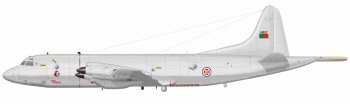
Portuguese Air Force (1988)
Prior to the arrival of the Orions in 1988 the Portuguese Air Force did not have any maritime patrol aircraft in its inventory. Search and Rescue or coastal patrol missions were conducted with C-130 Hercules or CASA 212 Aviocars. The Portuguese government recognized the lack of a maritime patrol platform and ordered six former Royal Australian Air Force P-3B Orions from Lockheed in 1985. These aircraft were traded in by the RAAF when the latter purchased ten brand new P-3C Orions. Mid October 1985 the first two Orions were ferried from RAAF Edinburgh to Montijo AB in Portugal. Almost immediately these aircraft were taken in use for flight crew training. Lockheed instructors were responsible for the early training courses. In the meantime Lockheed at Burbank was modifying one of the P-3B Orions to a new standard to meet the Portuguese requirements. It was not before March 1986 that the current Orion-squadron was established and the first so-called P-3P Orion arrived at the squadron in August 1988. Only one of the six aircraft was modified by Lockheed. The other five were reworked at the Oficinas Gerais de Material Aeronautico (OGMA) facilities at Alverca AB in Portugal. Operational training of mission crews was supervised by Lockheed instructors and took one and a half year. In mid 1989 Esquadra 601 reached the operational status with the P-3P: Portugal was back in the maritime patrol business.
The Portuguese Air Force had the intention of performing a capabilities improvement program for its six P-3P aircraft, in addition to a 25 year extension program of the aircraft's service life. The program, designated LECIP (Life Extension and Capabilities Inprovement Program) was divided into two sub-programs: Life Extension and Mission Systems Update. Under the Life Extension program airframe structural components and systems identified as having potential for significant impact on future aircraft availability due to excessive time/cost to repair are likely to be replaced. Structural improvements would have included replacement of the wings and stabilizers along the lines of the RNZAF "Kestrel" project. OGMA and Lockheed Martin signed a Memorandum of Understanding in connection with LECIP on 29 March 2000, but early 2002 the plans for LECIP were frozen. In December 2003 Portugal negotiated the possible purchase of Dutch P-3C Orions as a replacement for LECIP but after a review of the options the Portuguese parliament approved LECIP in July 2004. However, shortly after this decision LECIP was terminated in favour of the purchase of five RNLN P-3C Orions. A Letter of Intent was signed with The Netherlands on 17 September 2004 and a final agreement was signed on 21 February 2005.
Aero Union Corporation (1989)
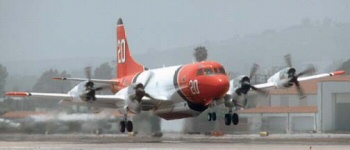
Mid 1989 Aero Union received its first Orions from AMARC through a US Forestry Service purchase program. Part of the transaction was that Aero Union had to trade in a "historic" aircraft (destined for military aviation museums) for every Orion they received. Aero Union was not allowed to pick the Orions themselves so they also received less suitable examples. These were being used as spare parts birds. The Orions were restored to flying condition at Tucson, AZ and flown to Chico Municipal Airport, CA in the Spring of 1989. Six P-3A's and one P-3B were modified into P-3A "Aerostar" firefighter aircraft: two in 1989, two in 1990, one in 1991 and two in 1992. During the modification the Orions were stripped of all equipment including the airconditioning and cabin pressure systems to reduce weight. Modifications lasted four to six months per aircraft. The tanks with a capacity of 3000 gallons were designed, produced and installed by Aero Union itself. They can be filled within 18 minutes. The Aerostars are used to fight forest fires in California, Arkansas and Oregon under a US Forest Service contract. One of the Orions was leased to the Allison Gas Turbine Division of General Motors as the in-flight test platform for the Allison GMA2100 (T406) turboprop engine with a six-bladed Dowty Rotol propeller. After the engine test program this particular Orion was modified to the Aerostar configuration and it was added to the fleet in the Summer of 1991.
Chilean Naval Air Force (1993)
In 1992 the Chilean navy expressed her interest in second hand Orions. At AMARC seven ex USN and one ex SpAF P-3A Orions were reserved for Chile. Early 1993 the first aircraft was taken out of storage and restored into flying condition by Western International Aviation Inc. of Tucson, AZ. This aircraft was handed over to Chile as a UP-3A in March 1993. The transaction was part of the Foreign Assistance Act which meant that Chile hardly had to pay anything for the Orions. Delivery of the eight UP-3A Orions was the first US military equipment delivery to Chile since the re-introduction of democracy after the resignation of president Pinochet in 1989. All weapons systems were removed form the Orions and the aircraft were primarily meant for coastal patrol, maritime surveillance, search and rescue and counter drug operations. By the end of 1994 all eight Orions had been delivered. Initial training of Chilean crews was done at the RNLN ground school and flight simulator at RNLNAS Valkenburg in The Netherlands. Additional training was provided by US company Tracor as well as at the flight simulator of the USN at NAS Willow Grove.
Four of the Orions were grounded almost immediately after delivery and used as ground instruction and spare part birds. Two of these (401 and 406) are being held in operational reserve and can be restored into flying condition within 35 days. 403 and 405 were completely dismantled. One of the remaining four aircraft is modified as a staff transport aircraft (408) under project "Parina" by a Miami based company. The other three are locally modified under Project "Imagen" with mission equipment based on systems used onboard of Chilean surface ships, helicopters and submarines. These three aircraft (402, 404 and 407) are equipped with data link, a French "Varan" radar system, Condor Systems ALR-801 ESM and a digital self-compensated MAD. All three operational Orions and the staff transport aircraft have been re-designated P-3ACH.
Royal Thai Navy (1995)
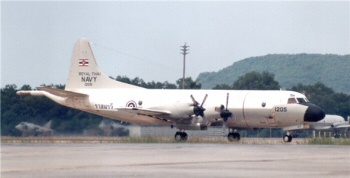
The Royal Thai Navy ordered three ex USN P-3A Orions in 1989. Deliveries were delayed for a couple of years due to financial problems and governmental changes in Thailand. In September/October 1993 the Orions destined for Thailand arrived at the NADEP at NAS Jacksonville, where the aircraft were modified to meet the Royal Thai Navy's requirements. Two aircraft were modified to P-3T (mainly based on the TAC/NAV Mod version) and delivered in February 1995. The third one was originally delivered as a UP-3T Orion in 1996, but was later modified to VP-3T standard. All aircraft received modern navigation systems and commercial color weather radars.
The VP-3T is a VIP bird with strengthened floor, passenger seats and a limited so-called SENTAC station which combines some elements of the Sensor 3 and TACCO stations, enabling the aircraft to perform light surveillance duties. The Orions were purchased as replacements for the Grumman S-2A/G Trackers and are operated by 102 squadron (initially with 101 squadron) alongside the Fokker F-27 Maritime Enforcers. The first Thai P-3 crews were trained by VP-30 at NAS Jacksonville and by Logistic Services International on location in Thailand. Next to the three operational Orions Thailand received two ex USN P-3A's which are used as spare part birds at U-Tapao AB.
Republic of Korea Navy (1995)
Despite the fact that Lockheed was about to close its P-3C production facilities at Palmdale, CA in September 1991, the South Korean government ordered eight P-3C-III+ Orions at the end of 1990. Besides the eight Orions, project "Yulgok" comprised the purchase of engines and spare parts as well as a crew training course with a total value of 840 million US Dollars. This included the costs of moving the entire P-3C assembly line from Palmdale, CA to Marietta, GA. Final assembly of the first Korean Orions started in February 1992. The roll-out of this aircraft was on 28 June 1994. The eighth and last aircraft was delivered to the RoKN in December 1995. Korean crew training started mid 1993 with USN VP-30 at NAS Jacksonville. After the Korean Navy initially refused to accept the first P-3C-III+ due to problems with the equipment, the first two aircraft were flown to Pohang AB by Korean crews on 25 April 1995. The Orions replaced a squadron of Grumman S-2A/F Trackers in the Republic of Korea Navy (RoKN). In 1996 Korea's plans foresaw in the purchase of another eight Orions for a second squadron at Cheju-Do AB, as well as a couple of second hand P-3A/B Orions for training and support duties. It lasted until 24 July 2002 before the US Congress approved the sale of additional Orions to South Korea. The second batch of eight Orions will not be new P-3C aircraft but surplus USN P-3B’s from the AMARC storage facilities. By the end of 2004 Korean Aerospace Industries (KAI) was awarded a contract for the modernization of eight P-3B Orions which will also go through a structure refurbishment program.
Hellenic Air Force / Hellenic Navy (1996 - 2009)
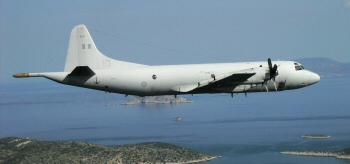
In 1990 the first plans for the purchase of some P-3 Orions were discussed with the US government. The latter offered to supply six P-3A Orions as part of a Defence Cooperation Agreement. This same arrangement made sure that the US were allowed to continue making use of some Greek military facilities like Souda Bay air base at Crete. Two years later Greece accepted the offer although due to the increased number of P-3B Orions available in desert storage, it was decided to deliver four P-3As (for ground instruction and spare parts) and six P-3B TAC/NAV MOD Orions for 353 Squadron's operations. The first P-3A arrived at the Hellenic Aerospace facilities at Tanagra AB in May 1995 where maintenance crews were trained to get ready for the new planes. The P-3Bs were restored into flying condition at the Aircraft Maintenance and Regeneration Center (AMARC) at Davis Monthan AFB and flown to Waco in Texas where the aircraft received attention from Raytheon E-Systems Inc. This company was responsible for some maintenance work, interior refurbishments and painting of the aircraft before their final delivery to Elefsis AB. The squadron is part of the Hellenic Air Force's 112 Combat Wing. However the Orions are owned and maintained by the Hellenic Navy. 353 Squadron operates the aircraft with a flight crew from the air force (pilots, flight engineer and the NAV/COM) and a mission crew from the navy. Operational requirements for the Orions are defined by the navy. In April 1996 a group of Logistic Services International (LSI) instructors took up residence in Athens for an 18-month training period. The training of Hellenic P-3 maintenance and flight personnel was conducted in-country at Elefsis AB, just 35 kilometers from Athens. With the arrival of the squadron's first P-3B in May 1996, LSI started the flight training for the first three Hellenic P-3 crews. Plans foresaw that the P-3s would probably have been equipped with systems that enable the aircraft to act as an on-scene command platform by transmitting real-time intelligence to command headquarters on shore or on board of NATO vessels. Also under consideration was the installation of an Electro Optical System (EOS) or an improved Infra Red detection System (IRDS) to improve the P-3's maritime surveillance role. Unfortunately, due to th poor economic situation in Greece there was no budget available for a life extension and upgrade program, forcing the Hellenic Navy and Air Force to ground the Orions. The very last Hellenic Air Force P-3 mission was flown in support of NATO exercise “Active Endeavour” on September 22, 2009. The next month 353 squadron was silently disbanded.
Argentine Navy (1997)
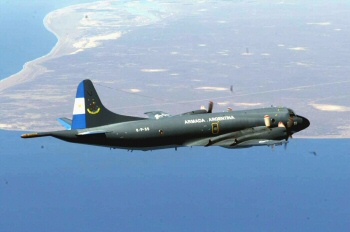
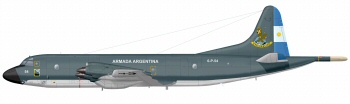
The Argentine Navy has been trying to purchase P-3 Orions for many years. The first time that the Armada intended to obtain Orions was during 1977,but the request was refused and Argentina was allowed to get four late production SP-2H Neptunes. The next attempt was in 1982 when the Argentine government agreed with Australia on the purchase of eight ex RAAF P-3B Orions. The contract for this deal was about to be signed on 4 April 1982 but when Argentina occupied the Falkland Islands two days earlier, the Australian government blocked the sale of the Orions to prevent that their old aircraft would ever be used in actions against British forces. Ten years later Argentina again expressed its interest in the Orion. A request for the delivery of a number of ex USN P-3A Orions went to the US government and when the Congress did not approve such a deal Argentina tried to purchase equipment and spare parts out of retired USN P-3 Orions for a modernization program of its fleet of L-188 Electra aircraft. Argentina was succesful in the fourth attempt to purchase some Orions for its naval air force. In 1997 six P-3B aircraft were made available from desert storage at AMARC. The first Argentinian P-3B Orion arrived at Almirante Zar AB on 7 December 1997. The sixth and last aircraft arrived there on 11 July 1999. Future plans involve the modification of one P-3B into an ELINT platform, replacing the current L-188 Electrón Wave. The Orions are operated by Escuadril Aviation 6 Expedition. They are currently operating four aircraft with the other two being in open storage.
Pakistan Navy (1999)
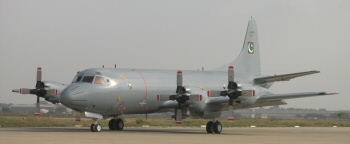
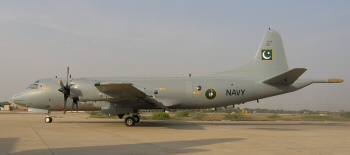
When India received a couple of Tupolev Bears from the Soviet Union it looked as if the US government wanted to restore the balance in the area. The delivery of three P-3C-II¾ Orions was approved in 1988. At the end of 1990 the aircraft were delivered to USN VP-30 at NAS Jacksonville, where Pakistan Navy crews started their P-3 conversion training in February 1991. After the training period the Orions would have been delivered to 28 squadron at PNS Mehran near Karachi. However mid 1991 it became clear that Pakistan was not willing to stop its nuclear programs. This situation resulted in an arms embargo against Pakistan and in January 1992 the US Congress decided that the Orions would not be delivered to the Pakistan Navy despite the fact that they already were formally handed over and paid for. The crew training program was abandoned and the three Orions were flown to the Aerospace Maintenance and Regeneration Center (AMARC) at Davis Monthan AFB by USN VP-30 crews. The aircraft remained there in storage until the end of 1996 when the US Congress authorized the delayed delivery of the aircraft. VP-30 crews flew them to Mehran in December 1996 and January 1997.
Since the Pakistan Navy only got the aircraft and not the necessary support and training it was not before 22 January 1999 that the Pakistani Chief of Naval Staff inducted the Orions into the Pakistan Navy. During 2000 the aircraft were reported to have been modified with chaff/flare dispensers and additional search and rescue capabilities. One of the three P-3C-II¾ Orions was lost in a tragic crash on 29 October 1999. Shortly after this crash the remaining two aircraft were grounded. By the end of 2005 Portugal’s OGMA was subcontracted by Lockheed Martin to bring the two P-3C Orions back into an airworthiness condition. The work is being done in-country at PNS Mehran and will last until April 2006. The program also involves some modifications. Because Pakistan has been cooperative in the American war against terrorism the US government is expected to approve the delivery of eight additional P-3C Orions in 2005. These aircraft, most likely P-3C-I Orions from AMARC, were offered at a price of 970 million USD including support and a nineth airframe for spares.
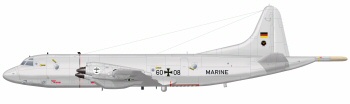
Germany (2006)
Lockheed Martin offered their Orion 2000 or P-3C Plus to Germany and Italy as early as 1997 as a possible replacement for their Br1150 Atlantic fleets. These two countries established a project management team in Koblenz, Germany after they signed an "MPA Definition MoU" on 21 October 1999. Their decision on an Atlantic replacement aircraft was expected by the end of 2001. Germany needed ten aircraft, Italy wanted fourteen and deliveries should take place between 2007 and 2015. On 26 July 2002 Lockheed Martin offered an improved version of the P-3C with re-designed wings, T56 engines and a mission equipment suite based on the USN’s BMUP and AIP variants. But the German/Italian program terminated and it looked as if the replacement of the Br1150 Atlantic was further away then ever. When in June 2003 the Dutch government announced its plans to sell its P-3C Orions, Germany became interested in the Orion again. On 31 October 2003 a Letter of Intent for the purchase of ten Dutch Orions was signed, pending Dutch and German parliamentary approval. Further negotiations with the Dutch and Portuguese governments lead to a final agreement for the delivery of eight P-3C CUP Orions to Germany, leaving the remaining five Dutch Orions available for the Portuguese air force. The sales contract for these eight aircraft was signed on 15 November 2004 and was worth 271 million euro for the eight aircraft, spare parts, flightdeck simulator, ground equipment and additional support. Another 24 million euro was paid for training of German ground technicians and flight crews at RNLNAS Valkenburg in The Netherlands. The German Navy’s 3rd Naval Air Wing (MFG3) training detachment at RNLNAS Valkenburg in The Netherlands took delivery of the first P-3C CUP Orion on 28 February 2006.
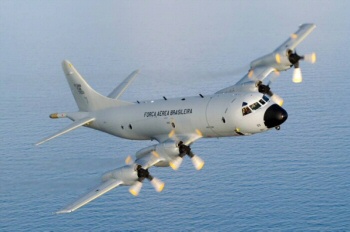
Brazil (2011)
Brazil first requested the US to deliver as many as 15 P-3C Orions in 1998. During 1999 this resulted in an offer for eight P-3A's for operational use and four P-3A's for ground training and spare parts. It was announced that the Orions would come into service with 4°/7°GAV at BA Santa Cruz and in 2000 Brazilian crews started P-3 Orion training with the Portuguese Air Force at Montijo AB in Portugal. Shortly after that the training program was suddenly cut off and the Brazilian P-3 program was delayed. On 4 November 2002 the Spanish EADS/CASA company was selected by the Brazilian government to modernize eight P-3A’s into P-3AM Orions with the Fully Integrated Tactical System (FITS) and Thales flightdeck instruments. Early May 2005 a contract for the modification of eight aircraft (plus one optional) was awarded to EADS/CASA. It is expected that the first P-3AM Orion will enter Brazilian air force service in 2011.
Republic of China Navy (2013)
The Republic of China Navy obtained 12 P-3C aircraft under the U.S. government’s Foreign Military Sales program in 2007. The aircraft are taken from desert storage at Davis Monthan AFB and will be completely overhauled and modernized by Lockheed Martin. Upgrades will include new mission system avionics and service life extension kits to extend the aircrafts’ service life for an additional 15,000 flight hours. Planned mission system upgrades include installation of electronic support measures, acoustics, communications, electro-optic and infrared systems, and new data management software and hardware, controls, displays and mission computers. The service life extension kits include new outer wings, center wing lower surfaces, horizontal stabilizers, horizontal stabilizer leading edges and nacelle components. The first modernized Republic of China Navy P-3C aircraft will be delivered in August 2013.