P-3 Orion Research Group
The Netherlands
this page was last updated on 2 January 2026
© P-3 Orion Research Group / 1997-2024
Lockheed Martin P-3 Orion Worldwide News Section
United States
The remaining number of active US Navy P-3 Orions in October is six (6):
VX-30 150521, 160293, 162999, 163291
VXS-1 158570, 158912
During July 2025 the final chapter about the three former Aero Union / Airstrike P-3A Aerostar firefighters which were sold by auction was written: N917AU had disappeared, N921AU was being scrapped and N923AU was still present at Sacramento McClellan Park, CA
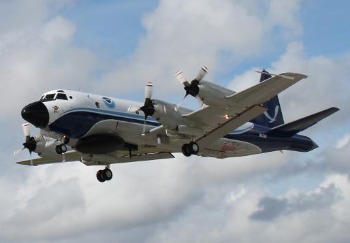
Both NOAA WP-3D’s, N42RF, ‘Kermit’ and N43RF ‘Miss Piggy’ were deployed to L.F. Wade IAP at Bermuda late September 2025 to monitor the Hurricanes Gabrielle, Humberto and Imelda. On 29 October NOAA WP-3D Orion N42RF headed straight into the eye of Hurricane Melissa to collect critical data that helps improve forecasts and research.
The US CBP sent a second P-3AEW&C (N142CS) to AMARG at Davis Monthan AFB for storage on 3 June 2025.
Argentina
The second P-3C (3297) for the Argentine Navy was delivered on 14 October 2025 from Keystone Heights City-Airport in Florida via Chaves Lima IAP to Cmdt Espora naval air base in Argentina. It will be re-registered 0890/6-P-58 and based at Alm. Zar (Trelew) naval air base. Although it has not been confirmed Scramble magazine reports that the first P-3C will be 0855/6-P-57. The third P-3C (3298) and the final P-3N (4576) are expected to be delivered during 2026.
Canada
The twelfth and final Block IV Aurora is 140117, which was on static display during the RIAT at RAF Fairford, UK on 19 and 20 July 2025.
On 6 August two CP-140M (140108 and 140113) arrived at JB Pearl Harbor-Hickam on Hawaii to participate in an exercise. During August two more CP-140M were flying missions out of JB Elmendorf (140115) and Keflavik (140101). The two from Hawaii and the one from Elmendorf all returned to CFB Comox on 23 August.
At JB Elmendorf #115 was replaced by 140113, early September.
From mid-September to late October CP-140M 140117 was flying out of Kadena AB in Japan for yet another deployment. Operation NEON is the Canadian contribution to the multinational effort to support the implementation of United Nations Security Council (UNSC) sanctions imposed against North Korea.
The RCAF had an Aurora detached to Keflavik: 140115 arrived on 20 October and left on 8 November. It was relieved by 140116, which arrived in Iceland on 6 November and left for CFB Comox again on 13 December.
14 Wing CP-140M 140118 has not flown since November 2024. It is in use as a ground trainer at CFB Greenwood, although it is kept in flyable preservation as a huge maintenance trainer. When the development use is complete 140118 will join the rest of the 14 Wing Aurora’s which are stripped for parts to maintain the last of the operational fleet. The current end of service date of the Aurora’s is 2030.
Chile
On 7 October it was 10 years ago since the arrival of the remains of Chilean Navy's P-3ACH # 402, at the country's main Aeronautical Museum. Not a single news has been heard or seen about it since then.
Germany
On 14 September specially marked P-3C 60+03 set off from its home base Nordholz to conduct a final farewell tour of epic proportions. The Orion had a large sticker on the nose with the text ’To infinity and beyond”. After visiting Amari in Estonia and RAF Lossiemouth it flew to Keflavik, CFB Greenwood, NAS Jacksonville and L.F. Wade IAP (the former NAS Bermuda). At Bermuda the crew encountered the two NOAA WP-3D which were present to monitor the hurricanes Gabrielle, Humberto and Imelda. As Gabrielle was heading for its next destination Lajes, 60+03 had to remain at Bermuda. During its stay at Bermuda a problem occurred on 25 September when the winglet of a taxiing Learjet damaged the left-hand wing of the stationary P-3C. At first the damage seemed unrepairable, however on 22 October a National Airlines Boeing 747 brought in spare parts. It looked promising when the aircraft made a local post repair test flight on Saturday 15 November, but nothing much happened after that. We understood that no airworthiness certificate was released which might indicate that (part of) the repair was not authorized. Anyway, 60+03 remained parked at Bermuda and it’s not known when it will be released to fly again.
Ever since P-3C 60+04 was flown to Beja in Portugal on 15 October 2025 no P-3C are flying out of Nordholz anymore. A ceremony to say goodbye to the P-3 was held at Nordholz on 20 November, “starring” maintenance trainer 60+22 on the ramp next to the first German P-8A 63+01.
On 8 December, aircraft 60+01 was towed from NAS Nordholz to the nearby Aeronauticum Museum via a parking area, and an empty cornfield. This Orion was withdrawn from use in March 2020, when a fuel tank exploded during a refuelling accident.
In December 2025 the situation of the remaining five German Orions was the following:
60+01 Aeronauticum museum at Nordholz
60+02 scrapped at Manching in November 2025
60+03 at L.F. Wade IAP, Bermuda; sold to Portugal but not airworthy after repair
60+04 stored at Beja, Portugal since 15 October; rr 24813
60+22 will be gate guard at Nordholz
Sadly, the Dutch plans to rebuild 60+02 and place it in a Dutch museum as 302 had to be canceled.
Greece
After more than a decade of delays, technical hurdles, and political controversy, the Hellenic Navy’s first upgraded P-3B Orion 153415 has successfully completed its maiden flight over Tanagra Air Base. This P-3B had not flown for about 15 years! The flight, which took place on 2 September 2025, marks a symbolic and operational milestone in what has been one of the most prolonged and problematic defense procurement efforts in recent Greek military history. Initially grounded by a series of setbacks -including a last-minute engine warning- the first modernized P-3 Orion finally took to the skies following exhaustive tests. Engineers from Hellenic Aerospace Industry (HAI) and Lockheed Martin conducted full engine runs and high-power taxi tests before clearing the aircraft for flight. The successful test marks the beginning of a new chapter for the Hellenic Navy, which has lacked a long-range maritime patrol aircraft for over a decade. The modernization of four P-3B Orion aircraft was approved by the Government Council for Foreign Affairs and Defense (KYSEA) in 2015, with the first delivery initially expected in 2019. The remaining three aircraft were scheduled for delivery by 2022. However, only the first upgraded aircraft has completed its maiden flight. In the meantime Greek crews are trained by MHD Rockland.
Japan
In July 203 Kyoiku Kokutai operating from Shimofusa said goodbye to its last P-3C Orions. The unit now operates three P-1s. In September it was reported that Japan is preparing to transfer up to six destroyers and several P-3C Orions to the Philippines by 2027.
Portugal
From 27 until 30 August P-3C CUP+ 14807 of 601 Sqn made a return flight from Beja to Recife/Guararapes IAP in Brazil to support the delivery of the first three A-29N Super Tucanos for the Portuguese Air Force. 601 Sqn deployed P-3C CUP+ 14809 to Lajes AB early September, to participate in the exercise ASAREX 2025. In September and October P-3C CUP+ 14807 of 601 Sqn was operating out of NAS Sigonella to conduct maritime situational awareness as part of NATO Operations IRINI, Sea Guardian and Noble Shield in the Mediterranean. On 1 November 14807 was replaced by P-3C CUP+ 14808, which stayed at Sigonella until the end of the detachment on 5 December. During the detachment the Portuguese clocked 240 flight hours in 56 missions. From 6 until 9 October P-3C CUP+ 14809 was performing SAR coverage during the delivery flight of the first four F-35A’s for the Belgian Air Force.
The fourth ex German Navy P-3C 60+04 arrived at Beja on 15 October. It was registered 24813 and put in storage with the other four.
On 15 December 14811 departed from Beja to Halifax. This aircraft had been grounded for eight years, servicing as a source for spare parts. IMP will upgrade its mission systems and this will complete the Block 1 upgrades. Block 2 will start after that.
Rumor has it that a second P-3 squadron is to be formed at Lajes AB in the Azores. It seems that crews are already learning the ropes with regards to the differences between the former German Orions and the Portuguese CUP+ variant. To better identify the differences between the aircraft, the Portuguese air force has changed the type designation for the former German aircraft into P-3C GER. Possibly this is just temporary.
On 20 November it the Portuguese Ministry of Defence announced it will invest €24 million between 2025 and 2028 to modernize five P-3C CUP II maritime patrol aircraft acquired from Germany. The upgrades are intended to meet NATO requirements and strengthen maritime surveillance, focusing on system standardization with the existing P-3C CUP+ fleet (including Link 16, AIS, and acoustic systems). Although Portugal also acquired a number of MLU kits, including sets of new wings, no structural upgrades appear to be included.
Republic of Korea
Two P-3C maritime patrol aircraft of the Republic of Korea (ROK) Navy have been upgraded through a collaborative effort between Get SAT, KT SAT, KAI Networks, and R4 Integration. This information comes from a press release dated 19 August. The upgrade is part of South Korea’s initiative to modernize ROK Navy’s long-range ISR fleet and improve airborne connectivity of its 15-aircraft P-3C fleet. Get SAT said that the two aircraft are equipped with its Milli H LW Ku-band terminal, a compact and lightweight terminal for airborne beyond-line-of-sight communications. With the support of KT SAT’s satellite network, the upgraded P-3Cs now benefit from real-time data links and persistent command-and-control communications.